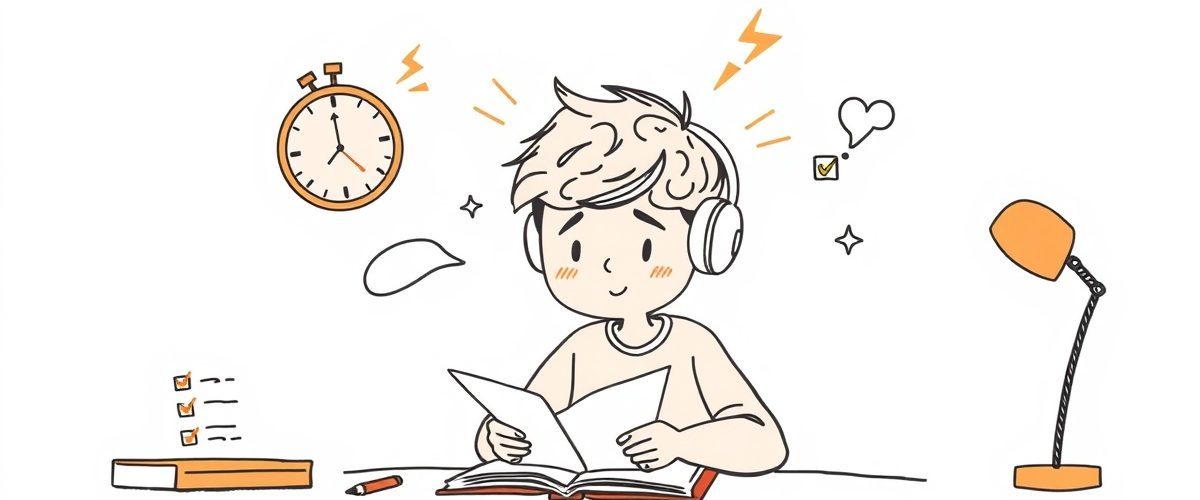

Studying with ADHD can feel like trying to read in a windstorm — words scatter, time disappears, and the harder you try to focus, the more elusive focus becomes. But here’s the truth: the problem isn’t your intelligence or your effort. It’s that most study advice was written for a brain that isn’t yours.
These ADHD study tips are different. They’re built around how the ADHD brain actually works — its love of novelty, its sensitivity to environment, its all-or-nothing energy bursts. Use them, and studying stops being a battle against yourself.
Why Standard Study Advice Fails Students with ADHD
The classic advice — “sit down, be quiet, read your notes” — assumes consistent attention and linear thinking. ADHD brains don’t operate that way. They’re high-interest engines: they run beautifully on topics that feel urgent or fascinating, and stall completely on anything that doesn’t trigger that spark.
The good news? You can engineer that spark. And once you do, an ADHD brain can outperform a neurotypical one — hyperfocus is a real superpower when it’s aimed at the right target.
Setting Up Your Study Environment
1. Create a Dedicated Study Spot (And Make It Weird)
Your brain forms strong associations between environments and behaviors. A couch says “relax.” A bed says “sleep.” You need a spot your brain learns to associate with work.
The twist for ADHD: that spot doesn’t have to be quiet. Many students with ADHD focus better with a low hum of background noise — a coffee shop, a lo-fi playlist, or even a white noise machine. Experiment until you find your sweet spot. The goal is consistent enough to trigger “work mode,” stimulating enough to prevent boredom drift.
2. Remove Friction From Getting Started
ADHD brains struggle with task initiation more than task execution. The hardest part is often just beginning. Reduce that friction ruthlessly:
- Keep your study materials already out on the desk
- Close every browser tab except the one you need
- Have your water, snacks, and everything else ready before you sit down
- Use app blockers (like Cold Turkey or Freedom) to make distraction require more effort than studying
The lower the activation energy to start, the more likely you’ll actually do it.
3. Use Body Doubling
Body doubling — studying in the presence of another person, even virtually — is one of the most underrated ADHD tools. Something about being observed (even by a stranger on a Zoom call) activates the ADHD brain’s social accountability circuits.
Try study halls, library sessions with a friend, or virtual co-working platforms like Focusmate. You don’t need to talk. Just being “with” someone helps.
Time and Focus Management
4. Work With Your Attention Span, Not Against It
Forcing yourself to study for two unbroken hours creates a pressure that almost guarantees failure. Instead, use structured short sprints.
The Pomodoro Technique (25 minutes on, 5 minutes off) is popular, but ADHD brains often need tweaking. Some students do better with 15/5, others with 45/15. Track a few sessions and notice where your focus naturally starts to drift — that’s your personal work window.
5. Use a Physical Timer (Not Your Phone)
This sounds minor. It isn’t. Picking up your phone to check a timer means seeing notifications, which means doom-scrolling for 20 minutes. A physical cube timer or kitchen timer keeps the countdown visible without the trap.
6. Timeblock Your Study Sessions on a Calendar
Vague plans (“I’ll study tonight”) evaporate for ADHD brains. Specific blocks (“7:00–7:45 PM — Chapter 4 review”) are much harder to ignore. Put them on a calendar with alerts. Treat them like appointments you’d be embarrassed to miss.
Learning and Retention Techniques
7. Active Recall Over Passive Re-Reading
Re-reading notes feels productive but barely moves information into long-term memory. Active recall — testing yourself before you think you’re ready — is dramatically more effective, and it keeps your ADHD brain engaged because it’s interactive.
Practical methods:
- Flashcards (Anki is excellent for spaced repetition)
- Blank page review: close your notes and write everything you remember about a topic
- Teach it out loud to an imaginary student (or an actual rubber duck)
8. Color-Code Everything
ADHD brains respond strongly to visual stimulation. A wall of uniform black text is hard to parse; a page with strategic color-coding gives your eyes anchors and makes scanning faster.
Assign colors by category: definitions in blue, examples in green, things you need to memorize in red. Consistency across subjects means your brain auto-sorts information as it reads.
9. Study in Multiple Short Sessions, Not One Long One
The spacing effect is well-documented in cognitive science: studying a topic across multiple shorter sessions beats cramming it into one marathon. This is even more true for ADHD, where mental fatigue hits faster and cognitive overload is a real risk.
30 minutes today, 30 minutes tomorrow, and a brief review the day after will outperform a 3-hour cram session every time.
10. Use Multisensory Learning
ADHD brains crave novelty and stimulation. Engaging multiple senses while learning increases engagement and retention. Try:
- Reading notes out loud while pacing
- Drawing concept maps by hand (the physical act of drawing aids memory)
- Listening to recorded lectures while doing something with your hands
- Using scented markers (the smell association creates an additional memory hook)
Managing Energy and Motivation
11. Study Your Hardest Subject First
Cognitive resources are highest at the start of a study session, before decision fatigue and mental tiredness set in. Tackle the most challenging, most resisted material first — even if it’s just for 15 minutes — then move to easier tasks as energy drops.
This works especially well with ADHD because the relief of finishing the hard thing creates a motivational boost that carries you forward.
12. Build In Rewards (Actually Follow Through)
External rewards work for ADHD brains because they create an artificial sense of urgency. The key is making the reward immediate and guaranteed — future rewards feel abstract and lose motivational power.
Set the rule before you start: “After I finish this problem set, I watch one episode.” Then actually do it. This builds trust with yourself, which matters more than it sounds.
13. Track Your Wins, Not Just Your Goals
ADHD often comes paired with rejection-sensitive dysphoria — an intense emotional response to perceived failure. If you only track what you didn’t finish, you’ll feel like you’re always behind.
Keep a “done list” alongside your to-do list. Write down what you actually completed. Reviewing it at the end of the day provides genuine positive reinforcement and a more accurate picture of your progress.
Dealing With Overwhelm and Procrastination
14. Break Tasks Down Until They’re Ridiculous
When a task feels too big, ADHD brains freeze. “Write essay” is terrifying. “Open a blank document and write one sentence” is manageable.
Break every task down past the point where it feels necessary. Not “study for history test” but “read pages 34–40 and write 3 bullet points about the main events.” The smaller and more specific the task, the easier it is to start — and starting is everything.
15. Give Yourself Permission to Stop
One of the most counterintuitive ADHD study tips: stop when you said you would. Forcing yourself to keep going past your planned end time breeds resentment toward studying and makes it harder to start next time.
When your timer goes off, stop. Rest. Then come back. Studying is a long game. Sustainable beats heroic every single time.
Building a System That Sticks
The goal isn’t to find one magic technique and stick with it forever. ADHD brains need novelty to stay engaged, which means your study system will need regular updates and tweaks.
Every few weeks, audit what’s working and what isn’t. Swap out techniques that have gone stale. Try something new. This isn’t inconsistency — it’s adaptation, and it’s exactly how ADHD minds thrive.
You don’t need to study like everyone else. You need to study like you. These ADHD study tips are a starting point, not a prescription. Take what works, leave what doesn’t, and build something that’s actually yours.
Quick Reference: ADHD Study Tips Checklist
- ✓ Create a consistent, slightly stimulating study environment
- ✓ Use body doubling for accountability
- ✓ Work in short, structured sprints with a physical timer
- ✓ Timeblock sessions on a real calendar
- ✓ Use active recall instead of re-reading
- ✓ Color-code notes by category
- ✓ Spread study sessions across multiple days
- ✓ Engage multiple senses while learning
- ✓ Tackle hardest material first
- ✓ Build in immediate, guaranteed rewards
- ✓ Track what you completed, not just what you didn’t
- ✓ Break tasks down into tiny, ridiculous steps
- ✓ Stop on time and come back tomorrow