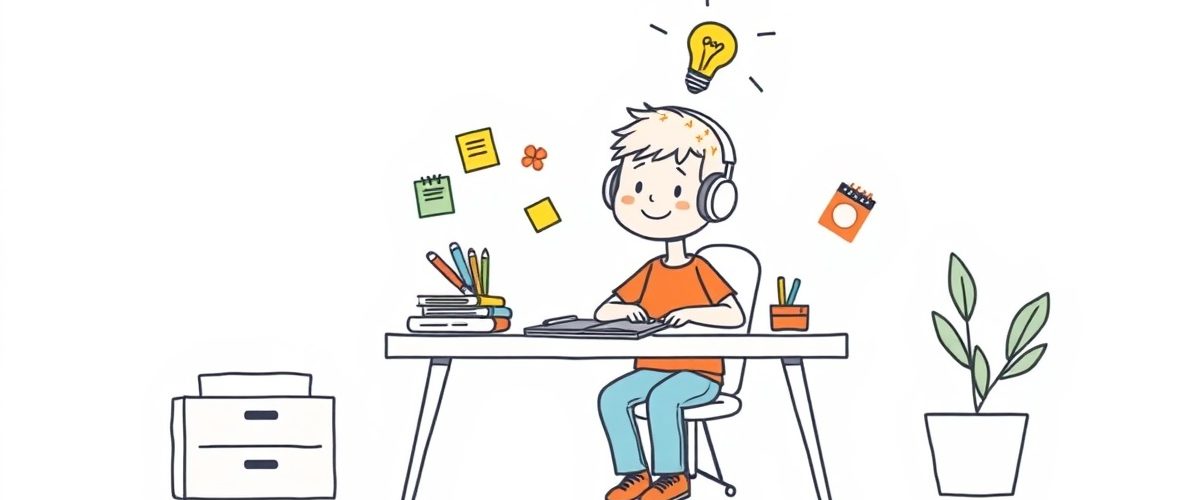

Creating an ADHD-Friendly Study Environment
Your physical environment shapes how well your brain can focus. People with ADHD often struggle in chaotic spaces where multiple stimuli compete for attention, making a thoughtfully designed study area essential for sustained concentration and task completion.
Start by removing obvious distractions from your immediate workspace. Close browser tabs, silence your phone, and keep only the materials you need for your current task within arm’s reach. Background noise presents a particular challenge—consider using white noise machines, brown noise apps, or instrumental music at low volume to mask unpredictable sounds like traffic or household activity.
Essential ADHD study environment setup includes four key elements: Remove visual distractions by keeping only current materials visible, control auditory input with white noise or noise-canceling headphones, organize supplies in labeled containers to prevent decision fatigue, and position your workspace near natural light with an ergonomic chair that supports proper posture.
Organization systems prevent decision fatigue that drains your mental energy. Color-coded folders, labeled shelves, and a consistent spot for each item mean you spend less time searching and more time studying. Your brain needs visual clarity, not hidden chaos behind closed doors.
Test your environment for one full study session before committing to it. What feels quiet might have a humming refrigerator. What seems organized might require adjustments after you actually use it. Small tweaks compound into major focus gains over weeks of studying.
Time Management Techniques for ADHD Students
Effective ADHD study tips start with time management systems that work with your brain’s wiring, not against it. Your working memory struggles to hold abstract deadlines, so concrete visual structures and frequent reset points become your tactical advantage.
The Pomodoro Technique pairs perfectly with ADHD brains because it breaks study time into 25-minute focused bursts followed by 5-minute breaks. During each interval, you commit fully to one task—no tab-switching, no phone checking. When the timer signals, you stop completely and step away.
Time blocking assigns specific time slots to specific tasks rather than creating open-ended to-do lists. Instead of “finish biology notes,” you calendar “biology notes Tuesday 2-3pm.” This removes the decision paralysis ADHD students face when staring at multiple tasks. Your calendar becomes your external brain, eliminating the need to remember what comes next.
Breaking large assignments into smaller chunks prevents overwhelm that triggers avoidance. A 20-page research paper feels impossible; “find three sources by Wednesday” feels manageable. Create a written task breakdown with interim deadlines for each component.
Visual schedules and physical planners outperform phone reminders for ADHD students. A wall calendar you see daily registers better than a notification you dismiss. Use color-coding to categorize subjects or due date urgency, and check off completed items immediately for a dopamine boost.

Active Learning Methods That Work for ADHD
ADHD brains thrive on movement and sensory input because physical activity increases dopamine and norepinephrine—the exact neurotransmitters your brain struggles to regulate. These ADHD study tips incorporate your whole body to transform studying from a chore into something your brain actually wants to do.
Walking while studying activates both hemispheres of your brain and improves information retention by up to 40% compared to stationary studying. Pace back and forth while reviewing vocabulary words aloud, recite historical dates while doing jumping jacks, or use a treadmill desk during online lectures.
Fidget tools aren’t distractions—they’re focus enhancers for ADHD minds. Stress balls, spinning fidget spinners, textured loops, or even doodling during lectures channel restless energy so your frontal cortex can concentrate on learning. Research shows that mild fidgeting improves working memory performance in people with ADHD.
Multisensory study techniques combine visual, auditory, and kinesthetic elements: Create colorful mind maps by hand instead of typing notes, use different colored pens for different concepts, speak your ideas aloud while writing them down, and physically manipulate flashcards or study materials. When information enters your brain through multiple sensory channels simultaneously, your hippocampus encodes it more deeply.
Interactive note-taking methods replace passive copying with active thinking. Cornell note-taking divides your page into three sections: a narrow left column for key concepts, a wide right column for detailed notes during lectures, and a bottom section for summary statements you write afterward.
Study groups provide social accountability and peer teaching—two powerful tools for ADHD motivation. Explaining a concept aloud to someone else forces you to organize your thoughts clearly and exposes gaps in your understanding. Set specific study group agendas and rotate who explains each topic so everyone stays mentally active.
Managing ADHD Symptoms During Study Sessions
ADHD symptoms don’t disappear when you sit down to study—they intensify. Your dopamine-starved brain fights against the low-stimulation task of reading textbooks or reviewing notes, creating an internal battle between what you need to do and what your nervous system craves.
Hyperfocus—the ability to lock onto an interesting task for hours—sounds like a superpower until it derails your entire study plan. You intended to spend 30 minutes on math homework, but suddenly you’ve spent three hours researching tangentially related topics. When you finally stop, you’re mentally exhausted with zero energy for actual priorities.
- Set a visible timer before each study session and treat the alarm as non-negotiable—when it rings, you stop immediately regardless of momentum.
- Start with your least interesting task during your peak focus window so you establish progress on priorities before hyperfocus pulls you elsewhere.
- Pre-commit to study session boundaries by telling someone your timeline or working in a location with built-in time limits.
Attention switching—the opposite problem—hits harder for many ADHD students. Your brain can’t settle into any task for more than a few minutes before jumping to something else. You read a paragraph and realize you have no idea what it said because your mind wandered to lunch plans or random memories.
Combat attention switching by reducing decision points during study sessions. Put your phone in another room, close all browser tabs except the one resource you need, and tell your study partner or family to not interrupt you. Make the path of least resistance the path toward studying, not away from it.
Motivation with ADHD isn’t about trying harder—it’s about engineering your environment and task structure so your brain naturally wants to focus. Your prefrontal cortex requires adequate dopamine to experience tasks as rewarding, and ADHD brains produce less dopamine during routine activities.
Five evidence-based motivation strategies for ADHD students: Use novelty injections by changing study locations every few days, create artificial deadlines with social accountability, pair studying with immediate rewards after each 25-minute interval, make progress visible through tracking charts, and study with accountability partners who can observe your work sessions.
Break management determines whether you can sustain studying across multiple hours or crash partway through. ADHD brains need more frequent breaks than neurotypical brains because sustained attention depletes your dopamine faster. Strategic breaks aren’t laziness—they’re essential maintenance that keeps your system functioning.
The timing and structure of breaks matters enormously. A five-minute break scrolling your phone doesn’t actually reset your nervous system. True breaks require movement: walk around your house, do a quick workout video, stretch while looking out a window, or run up and down stairs.
Self-care during study season determines your long-term focus capacity. Sleep deprivation, skipped meals, and dehydration don’t just feel bad—they directly impair attention and executive function, making ADHD symptoms worse. Build non-negotiable self-care into your study schedule by drinking water continuously, eating balanced meals before intensive studying, and protecting your sleep schedule fiercely.
Frequently Asked Questions
What are the best study techniques for ADHD students?
The most effective ADHD study techniques include the Pomodoro Technique for time management, active learning methods like movement-based studying, creating distraction-free environments, and using visual aids like mind maps and color-coded notes.
How can ADHD students improve their focus while studying?
ADHD students can improve focus by eliminating distractions, using background white noise, taking regular breaks, studying during peak attention hours, and employing fidget tools to channel excess energy productively.
What time management strategies work best for ADHD?
Effective time management for ADHD includes using visual planners, breaking tasks into smaller chunks, time blocking for different subjects, setting realistic deadlines, and using timers to maintain awareness of time passage.
How should ADHD students organize their study materials?
ADHD students should organize materials using clear labeling systems, color-coding for different subjects, designated spaces for everything, digital organization tools, and regular decluttering to maintain an organized study environment.